Showing posts with label Infiniti. Show all posts

Saturday, December 18, 2010

Infiniti G37 convertible will be available in November


The company Infiniti plans to launch the Infiniti series production G37 coupe versions open early next year. This is stated in an official communication companies, circulated on Thursday.

World debut of new items planned for November this year and will take place in the showroom in Los Angeles, and in that car sales will appear in mid-2009. The public version Infiniti G37 will get tough emerging roof, consisting of three parts, and its main competitor will be BMW 3-Series with the same type of body. The engine for the coupe-cabriolet pozaimstvuyut from the same compartment Infiniti - it will be 330 - a strong volume of 3.7 liter V6.

In addition, next year at the Infiniti G37 coupe version will appear with a system full of drive ATTESA E-TS, and instead of six "machine" for all cars Series G (including sedan) will be fitted seven-speed transmissions.

Infiniti M has exposed to severe finishings


Infiniti M became even more perfect: the sample piece of 2008 has exposed to severe finishings. It has received intellectual all-wheel drive system ATTESA E-TS and propeller V8 in size of 4,5 litres. Now buyers will choose from two sample pieces: new M45 and previous M35.

In M45 the interior has varied - the interior became more magnificent and friend. Safety Infiniti M above all praises: the vehicle have equipped with hi-tech system LDP. Among pleasant options 2 the updated navigation, the drive in size 9,3 ??, Bluetooth and the 7-inch LCD-shield.

Outside the front bumper, a crate, rear head lamps and other parts of a basket have exposed to finishing. The vehicle has received new 18-inch and 19-inch sports wheels from an aluminium alloy, writes Topspeed.

Test-drive 2009 Infiniti G37 Sedan

Recently, Infiniti persistently tries to ensure that its cars have become popular in Western Europe. The powerful diesel engine for its cars still under development, the company equips all of its European car series G is also quite good petrol V6. Recent advances in this area - 3.7 liters. VQ37VHR V6, which works under the hood 2008 G37 Coupe. And it is obvious that the new G37 Sedan engine is not worse.

So, we finally get the long-awaited 2009 Infiniti G37 Sedan. Another technical innovation, which can boast of this car - the seven-speed automatic transmission, which replaced a six-speed machining (it was last year's model is equipped with a machine)

However, none of these improvements do not make the new G37 is much faster than its predecessor. However, progress is clearly - Infinity has established a really good sports sedan.

Infiniti G37 Sedan
Infiniti G37 Sedan

Tuesday, November 16, 2010

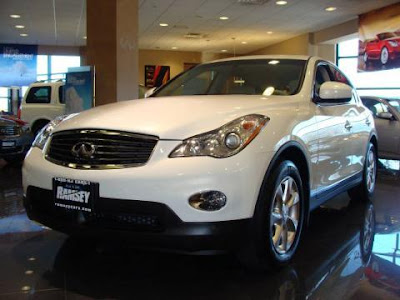
Reviewing the 2010 Infiniti EX35

Reviewing the 2010 Infiniti EX35
Reviewing the 2010 Infiniti EX3, Why have car-based "crossover" wagons becoming so popular? That's simple enough. They're roomy like SUVs, usually look rugged like an SUV - and do about as well in the rain and snow as a truck-based SUV does - but without the truck-based SUV's typically clunky handling and hearty thirst for fuel. Almost all of them have one big downside, however.


That downside - if you're an enthusiast driver - is that nearly all current crossover wagons are based on front-wheel-drive layouts, usually with an all-wheel-drive system of some kind available optionally. If you want rear wheel drive (with a RWD-based AWD system) and the superior high-speed handling/balance that comes with it, you're pretty much out of luck. One of the handful of exceptions to this rule is Infiniti's rear-drive-based EX35

WHAT IT IS

The EX35 is a compact, 5-door hatchback sportwagon - aka, a "crossover" - that differs from most crossovers currently on the market in that it's built around a rear-wheel-drive (instead of front-wheel-drive) passenger car drivetrain and chassis. As such, it offers performance/handling characteristics very much like a RWD sport sedan's. Main competition is the BMW X3 and the Mercedes-Benz GLK - both of which are also based on RWD layouts, but which lean more toward the SUV-like side of the aisle than the sport sedan side of the aisle.

WHAT'S NEW for 2010

The EX35 was introduced last year as an all-new model, so changes for 2010 are incremental. All trims now come standard with USB ports for the audio system and the optional GPS system has been updated with Real Time Traffic and Weather assistance.

Also new is a noticeably higher sticker price. The base 2010 model with rear-wheel-drive starts out at $33,800 vs. $31,900 in 2009. The range-topping Journey model with AWD is priced at $37,400 - vs. $36,850 in 2009.

WHAT'S GOOD

Runs - and corners - like the G-series sport sedan it's based on. Brawny (297 hp) V-6 is standard equipment. RWD versions can do burnouts; AWD versions won't get stuck in the snow. Ingot-like solidity outside; beautifully crafted on the inside. Still a deal compared to the $38,850 BMW X3. Stronger than the 268 hp $35,500 Benz GLK.

WHAT'S NOT SO GOOD

The major uptick in price. Where's the six-speed on the floor? Drinks gas like a '76 Eldorado.

UNDER THE HOOD

One of the EX's standout features is its high-powered (and standard equipment) 3.5 liter V-6. It is the same basic engine as used in the current G-series sport sedan, as well as the Nissan 370-Z. It's just slightly smaller in displacement and tuned-down a tad to just under 300 hp. Still, that's power enough to launch the EX from zero to 60 mph in about 6.3-6.5 seconds seconds (RWD versions are quickest), which makes the EX one of the fastest things going in its segment.

The EX's main competition - the 260 hp BMW X3 and the 268 hp Benz GLK - are significantly less powerful, much heavier - and not nearly as quick. The X3, for example, needs about 7.2 seconds to make it to 60 mph. However, you can get a manual transmission in the BMW (a feature not offered with the Infiniti). BMW also has an updated version of the X3 on deck for 2011 that will likely have more power, too.

Still, the EX is near the top of the pile as far as muscularity goes. Several FWD-based competitors like the Acura RDX and VW Tiguan don't even offer V-6 engines and their fours max out around 240 hp - not even in the same ballpark as the EX35's close-to-300-hp V-6.

A five-speed automatic is standard in the EX. It features "sport" programming that can be accessed by pushing a button on the console. This allows driver-control of up and down gear changes. There's also a "Snow" mode that starts the transmission out in second gear (and reduces the aggressiveness of throttle tip-in) to improve grip on slick surfaces.

The EX's optional AWD system differs from the more common (in crossovers) set-up in that, being based on a rear-wheel-drive layout, most of the engine's power goes to the rear wheels, most of the time. As the rear wheels begin to slip, some of the engine's power is automatically routed to the front wheels, to maximize traction. In front-wheel-drive-based systems, most of the engine's output normally goes to the front wheels, until they begin to slip - at which point the system kicks back power to the rear wheels.

What's the difference - and why does it matter? The RWD-based system (with most of the engine's power going to the rear wheels most of the time - and with the weight of the powertrain more evenly spread out from front to rear) gives better handling dynamics on dry, paved roads. A FWD-based system (with most of the engine's power going to the front wheels most of the time - and with most of the powertrain's weight on top of the front wheels) will give better grip on wet/slick roads, along with handling characteristics that are more forgiving of non-expert driver mistakes, such as carryinf too much speed into a decreasing radius turn. The RWD-based vehicle will tend to kick its tail out when this happens, which can be dealt with by applying more throttle and counter-steering. But this is a technique many average drivers haven't mastered. Which is why a FWD-based vehicle - which will typically understeer, or "plow" toward the inside of the turn taken with too much speed - is more controllable and thus safer for the average driver.

But there's a price to be paid - at the pump - for all this high-performance goodness. The EX wants premium fuel only and it wants it often. EPA rates this hawg at an impressively gas-guzzly 17 MPGs in the city and 24 MPGs on the highway. AWD versions knock it down to a suck-a-licious 16 MPGs in city driving and 23 on the highway. In the EX's defense, the X3 and GLK are about as bad, fuel-efficiency-wise. And they're not nearly as powerful - nor as fun to drive (see below). Still, Exxon-Mobil will just love you if you buy this ride.

ON THE ROAD

The EX may be the best handling vehicle of its type on the road. RWD versions behave very much like a RWD sport sedan, which shouldn't be surprising given the EX's heritage. It is basically a wagonized version of Infiniti's excellent G-series sport sedan - and rides and drives very much like it.

Most crossovers are either SUVs in drag - or wanna-be SUVs based on FWD passenger cars. This forces compromises in driving dynamics for the sake of off-road/poor weather bona fides. For example, the BMW X3 - which, being based on a rear-drive layout is closest to the EX in concept - is available only with full-time AWD and is set up to be more of a sporty all-weather SUV than an out and out sport wagon like the EX35. The Benz GLK (based on the C-Class sport sedan) comes in both RWD and AWD versions, but the 30-something horsepower deficit gives the EX an obvious edge over the Benz sportwagon.

Further evidence of the EX's tilt toward the sport side of the balance sheet is its standard/available wheel and tire packages, which include dry road-biased and very high-performance "W" (up to 168 mph) speed rated 18-inch performance tires. The BMW X3's standard tire is only "H" (up to 130 mph) rated.

Other factors that affect handling feel/cornering prowess are ride height and weight. The EX35 sits much lower to the pavement, with only 6.5 inches of clearance vs. the X3's 8 inches (and nearly the same for the GLK, which has 7.9 inches of ground clearance). That is a significant difference you really can feel in a high-speed turn.

The 3,757 lb. EX35 is also much lighter than the downright fatty 4,012 lb. X3 and the nearly two-ton (3,979 lb.) GLK. The lower unsprung mass - and the higher output engine - endow the EX35 with a much more athletic feel.

If only Infiniti offered a manual transmission, this thing would really rock. Even so, the standard five-speed automatic gives the operator much more control over gear changes (when in Sport mode) than most other automatics - which frequently won't let you move down a gear (or up) until the computer decides you're at an acceptable road speed or RPM.

In the EX, you can drop down to (and hold) a lower gear sooner - and for longer - which almost makes up for the absence of a clutch.

AT THE CURB

The EX looks like what it is - a wagonized version of the G-series sedan. It's much more restrained-looking than the wild-child FX (the EX's big brother) which is even more wild-looking for 2010. The EX's look is less dramatic, but it's also less polarizing than the FX.

The interior layout of the EX is also similar to the way the G-series sedan's laid out. It is much less SUV (or even crossover) like and more sport sedan-like, with a curving "double wave" dash that flows into the door panels and recessed LCD display for the GPS in the center stack. It is finished with black lacquer and aluminum trim plates or - optionally - wood veneer inserts.

One area where the EX is lacking relative to competitors like the BMW X3 and Benz GLK is cargo capacity. Behind the rear seats, there's only about 19 cubic feet of space vs. the BMW's 30 cubic feet and the Benz GLK's 23.3 cubic feet. Also, the back seat area is noticeably tighter, too. There's just 28.5 inches of legroom for rear seat passengers vs. 35.8 in the X3 and 35.1 inches in the GLK. Max tow rating is 3,500 lbs. - same as the GLK and X3.

THE REST

Though several Infiniti models are either based on or share major components such as platforms and engines with less prestigious Nissan-branded models, Infiniti does a very effective job of putting distance between them - and not just price-wise.

The base EX, for example, comes with a high level of standard amenities, including automatic climate control, electric sunroof, premium stereo with factory satellite radio hook-up, 17 inch alloy wheels and Infiniti's unique self-healing paint. The finish has high-elastic resins that let it expand to fill in small scratches without ever needing to visit a body shop - or get out the buffing compound. With a starting price point of $33,800 the EX is also considerably less expensive than its most direct competitor, the BMW X3 ($38,850 to start), even factoring in the not-small uptick in MSRP for 2010.

Lots of safety equipment - both built-in crashworthiness and active accident-avoidance features - is a given on a vehicle such as the EX35. But in addition to the things you'd find in ay other similar in price vehicle, such as high-capacity disc brakes with ABS, side-impact and curtain air bags, traction and stability control, the EX35 goes up another notch with an available full perimeter Around View camera system that gives you a 360 degree bird's eye look around the entire vehicle, as if you were floating 10 feet above it. It works when you're moving forward as well as backing up, too - and makes it almost impossible to not notice something that you might otherwise bump into or drive over.

The EX also offers an optional Lane Departure Warning that beeps at you if you wander too near the double yellow line in the road. And this system does more than just beep at you, too. If the driver doesn't make a steering correction to get the vehicle back on track, the system will do that for him - automatically.

THE BOTTOM LINE

The EX may look like a crossover SUV but it's really a sportwagon, with more power than most - and better reflexes than any (in its price range, at least). And that puts it in a class by itself.

Thursday, July 29, 2010

2011 Infiniti QX56


The 2011 QX provides 400hp and 413lb-ft of torque from its direct-injected 5.6l V-8. Customers have the option of rear-wheel drive, or Infiniti’s All-Mode 4WD. The QX is packed full of standard tech, including Infiniti’s hard-drive based navigation, Bose Stereo, USB Connectivity, Intelligent Cruise Control, Frontal Collision Warning, and Intelligent Brake Assist. Rather impressively, Infiniti is offering a majorly improved QX for the same price as last year’s model. The range starts at $56.7K for rear-wheel drive, and $59.8K for four-wheel drive.

Tuesday, July 20, 2010

Reviewing the 2010 Infiniti G37 convertible


Reviewing the 2010 Infiniti G37 convertible

Glacier Blue metallic was just the right color for the G37 retractable hardtop convertible that got dropped off in my driveway for evaluation one day before we got pummeled by two feet of early December snow. Rear wheel drive, summer tires - and a drop-top roof. It's the equivalent of taking a rubber knife to a gunfight.

But I managed to get one good day's drive in before the G was entombed for the duration.

WHAT IT IS

The G37 is a mid-sized luxury-performance sport sedan/coupe/retractable hardtop coupe. The retractable hardtop convertible was introduced to the lineup in the summer of '09. Prices start at $43,850 for the base rear-drive version with automatic transmission and run to $43,900 for the Sport version with six-speed manual transmission.

WHAT'S NEW

In addition to the new three-piece retractable hardtop, the G37 retractable hardtop has slightly different exterior bodywork (compared with the coupe) and there are some subtle changes to the rear track/suspension. The optional GPS navigation system now has DVD playback capability - and there's an updated gauge cluster, center stack and console.

All-wheel-drive will reportedly be offered later in 2010 (it's already available with the G37 coupe and sedan).

WHAT'S GOOD

Brilliant retractable hardtop; 370Z levels of power/performance/handling (same basic engine/drivetrain and a similar chassis layout) with more space inside (four seats vs. the 370Z's two). Supermodel good looks with the top up or down. Costs a lot less than a BMW 335i soft-top convertible ($50,700). Stronger standard V-6 than the just-launched retractable hardtop Lexus IS350C (306 hp) and has a manual transmission - which you can't get in the automatic-only Lexus.

WHAT'S NOT SO GOOD

Brilliant retractable hardtop adds about $9k to base price vs. G37 hardtop coupe. Also adds nearly 500 pounds of curb weight.

As helpless in the snow as a supermodel in an evening dress and high heels.

ENGINES & PERFORMANCE

The G's standard 3.7 liter V-6 engine is basically the same as the 3.7 liter V-6 used in the Nissan 370Z sports car - with posted horsepower (325) just slightly down from the Z-car's rated output (332 hp).

Another similarity the G shares with its Z-car cousin is the availability of a close-ratio six-speed manual transmission or seven-speed automatic with paddle shifters.

The big difference, drivetrain-wise, is that the G37 can be ordered with a full-time all-wheel-drive system (the Z-car is rear-drive only).

Adding the retractable hardtop - and the extra chassis bracing needed to maintain the structural rigidity of the body - also added some 460 pounds to the car's curb weight, bulking it up to 4,095 lbs. vs. 3,633 for the G37 coupe. The extra poundage subtracts some performance as well as some fuel economy. The G37 retractable hardtop clears 60 mph in about six seconds flat with rear-wheel-drive and six-speed stick - which is about half a second slower than the coupe. Gas mileage drops slightly from the coupe's 18 city, 26 highway to 17 city, 25 highway.

AWD will likely add about another 200 pounds.

DRIVING IMPRESSIONS

If you test drive the hardtop coupe and retractable hardtop convertible back to back - with the roof up, for the convertible - it's hard to tell the difference between the two, despite the retractable hardtop's considerably higher curb weight. The hardtop coupe is quicker, of course - but that quarter to half-second difference is something you need a stopwatch to notice. And when you factor in such things as driver reaction time/ability (for stickshift versions) it's pretty much a wash.

The 3.7 liter V-6 has power to spare - and easily copes with the G's two-ton curb weight. Same with the handling.

On a track - or if you're driving like you would if you were on a track - the retractable hardtop's additional bulk will cause you to lose a step relative to the hardtop coupe. But we are talking fractions of a second's difference, like winning (or losing) the Kentucky Derby by a nose. Both versions have grip thresholds that will satisfy all but the truly maniacal (and high-skilled). Though it's a high-performance two-door, the relatively long wheelbase (112.2 inches) imparts a less darty feel than its short-wheelbase (100.4 inch) Z-car cousin, but with similar steering precision and overall balance. This probably means the average driver will be able to drive the G more aggressively with a higher confidence level than the more expert-oriented Z-car. Take two average drivers, give one a G and the other a Z and it'll be a pretty even race.

But the really impressive thing about the retractable hardtop is how little you notice it is a retractable hardtop - when the top is up. It's just as quiet, just as secure-felling as the coupe. If you have access to a series of railroad ties or "Belgian blocks," you can abuse the car and summon forth some rooftop and A-pillar movement. But again, it's something that's all-but-unnoticeable on the street, in real-world driving.

The car's big functional limitation is the same limitation that applies to all low-slung sporty rear-wheel-drive cars equipped with high-performance tires: It sucks in the snow. And don't think all-wheel-drive will help much. In a car like the G, all-wheel-drive is intended mainly to improve handling on dry and wet roads. Snow is a no-go. The car still sits low, it still has tires that have no business leaving the driveway when the flakes begin to fall. Bum a ride.

STYLING & UTILITY

The retractable hardtop's body is slightly different here and there relative to the coupe - but as with the extra weight, it's something you notice more on paper than in real life. For example, the retractable hardtop is about 1/4 inch longer overall. It's not something you can tell by just looking. Overall, the lines are very similar - and it's easy to mistake the retractable hardtop for the standard coupe - until the top goes down.

That process takes less than 30 seconds - with the works disappearing gracefully into a storage area behind the rear seats. Of course, all that stuff doesn't actually disappear. It ends up folding into the trunk/cargo area - leaving only about 5 cubic feet of capacity vs. 7.4 for the hardtop coupe. But, again, this is a fact of life with any retractable hardtop (and most soft-top convertibles, too).

The main thing I'd worry about is what happens when, down the road (and after the warranty expires) something goes wrong with the hugely complex (and thus, expensive) retractable hardtop mechanism. The rich people who buy a car like this new probably don't worry about it since they're rich - and besides, they don't keep cars longer than five or six years anyhow. The second owner may feel differently... .

As a two-plus-two, the G37 has a set of small but at least conceivably usable rear seats - maybe not for people (a low roofline and minimal legroom ensure that) but for the stuff that you'd otherwise have to leave behind if all you had available was the trunk.

QUALITY & SAFETY

It is becoming more and more difficult to objectively distinguish between what are considered "entry luxury" cars (with opening prices in the mid-high $30k range) and full-on "luxury" cars - as far as the look and feel of the materials, the features in the car and so on. Increasingly, the chief differentiator is price rather than content. The "luxury" cars simply cost more than the "entry luxury" cars. That's ok, I guess, if you're paying more just so you can say you own a more expensive car than Bob next door has. But if you blind-tested a car like the G37 against something that cost another $20k more, it'd be a real challenge to tell which car carried the higher price tag, just by what you get. Stuff like the G's standard self-healing paint (it's flexible enough that minor scratches are gradually absorbed), Bose Open Air sound system with headrest mounted speakers that modulates the sound output to compensate for outside noise, adaptive climate control that adjust fan speed in relation to top position and vehicle speed, Intelligent Cruise Control that maintains your set speed even on downhill grades, radar-based automatic braking, heated and cooled front seats, hard-drive GPS navigation - the proverbial "works."

Some of this stuff you have to buy in a package - which not only bumps up the price but also forces you to buy some items you may not especially want in order to get the things you do. But there's no finding fault with the state-of-the-artness, opulence or put-togetherness of the G.

Convertible-specific safety upgrades include pop-up rollbars (they deploy if sensors detect a possibly imminent rollover) and a wind deflector to mute buffeting at high road speeds. The rest - ABS, traction and stability control, a full complement of air bags - are givens for a car in this class.

THE BOTTOM LINE

A perfect ride for Pacific Coast Highway - but not the hot ticket for the Appalachian mountains in the middle of a bad winter.

Twitter Delicious Facebook Digg Stumbleupon Favorites More

 
Powered by Blogger | Printable Coupons